Table of Contents
The Manual Operations Trap
Your infrastructure works fine when you SSH into servers and manually configure them. But as your business scales, manual operations becomes your bottleneck:
- Provisioning a new environment takes 3 days instead of 3 minutes
- You can't reliably reproduce production in staging
- Deployments are error-prone because they depend on human memory
- Scaling requires hiring more ops engineers, not technology
- Configuration drift causes mysterious production issues
Three Pillars of Infrastructure Automation
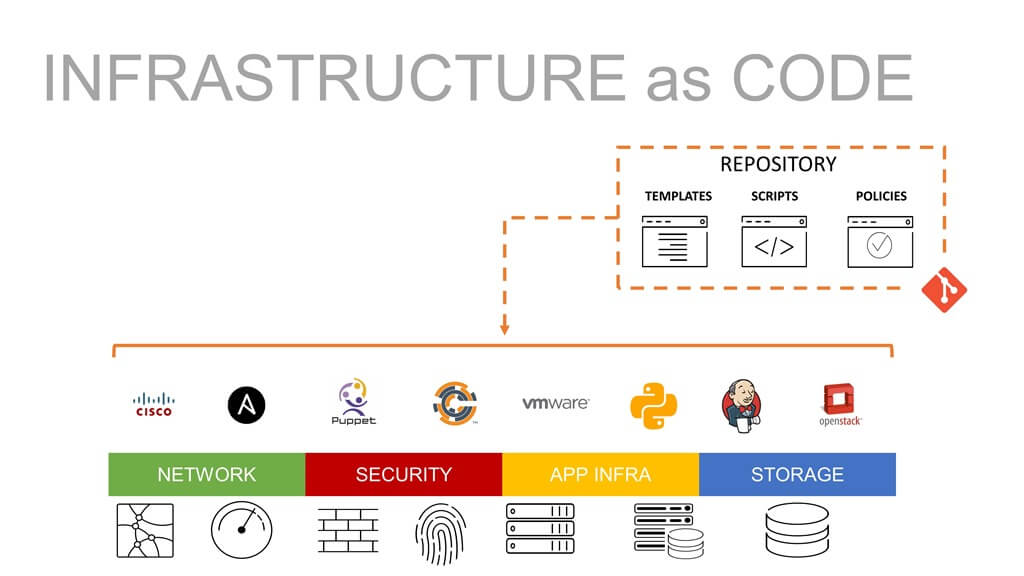
1. Infrastructure as Code (IaC)
Instead of clicking cloud consoles, define infrastructure in code. Tools like Terraform, CloudFormation, and Pulumi let you version-control your infrastructure, review changes like code, and deploy consistently.
Benefits: Reproducible environments, disaster recovery (rebuild from code), collaboration, audit trails, and the ability to stand up new regions in minutes.
2. Configuration Management
Once infrastructure exists, it needs to be configured—packages installed, services started, security rules applied. Ansible, Chef, and Puppet automate this configuration consistently across hundreds of servers.
Real-world impact: A startup with 20 servers can apply security patches to all 20 simultaneously, consistently, with full documentation.
3. Deployment Automation & CI/CD
Your code should flow from repository → testing → staging → production with zero manual steps. CI/CD pipelines catch errors before production, enable frequent deployments, and make rollbacks trivial.
Getting Started: A Practical Roadmap
Phase 1: Infrastructure as Code (4-6 weeks)
Goal: Define your current infrastructure in Terraform/CloudFormation
- Audit current infrastructure (networks, servers, databases, load balancers)
- Write IaC modules for each component
- Test: destroy and rebuild environment from code
- Set up state management (remote state, locking, backups)
Phase 2: Configuration Automation (4-6 weeks)
Goal: Automate server configuration and package management
- Select configuration management tool (Ansible is easiest for startups)
- Create playbooks for each server type (web, database, cache, etc.)
- Integrate with IaC (run Ansible after Terraform provisions)
- Test full provisioning: clean cloud account → fully configured production-ready system
Phase 3: Deployment Automation (4-8 weeks)
Goal: Push code from repository to production with zero manual steps
- Set up CI/CD platform (GitHub Actions, GitLab CI, or Jenkins)
- Automated testing (unit, integration, security scanning)
- Automated staging deployment for every merge request
- One-click (or automatic) production deployment
Immediate Quick Wins (Do These First)
Security Scanning: Integrate tools like Snyk or Dependabot to automatically scan dependencies for vulnerabilities during every build. Catch security issues before they reach production.
Automated Testing: Add test automation (unit tests, integration tests, E2E tests). Tests catch 50%+ of bugs before QA, dramatically reducing manual testing burden.
Infrastructure State Backup: Document your current infrastructure in code and version control it. Even without full automation, you now have disaster recovery capability.
Tools Most Startups Use
| Category | Popular Tools | Best For |
| IaC | Terraform, CloudFormation, Pulumi | Cloud infrastructure |
| Config Management | Ansible, Chef, Puppet | Server configuration (Ansible easiest) |
| CI/CD | GitHub Actions, GitLab CI, Jenkins | Deployment automation |
| Monitoring | Prometheus, Datadog, New Relic | Real-time system visibility |
Expected ROI from Automation
Time Savings: 70% reduction in manual operations. A task taking 3 hours monthly drops to ~50 minutes.
Reliability: Configuration consistency reduces production incidents by 40-60%.
Deployment Speed: Manual deploys (3-4 per month) → automated deploys (10-20 per month).
Risk Reduction: Rollbacks take 5 minutes instead of 2 hours.
Common Pitfalls to Avoid
- Over-engineering: Start simple. Terraform + Ansible + GitHub Actions covers 95% of use cases.
- Skipping testing: Automate your test suite first. CI/CD without tests just deploys bugs faster.
- Manual state: Use remote state (Terraform Cloud, AWS S3 with locking). Local state is a disaster waiting to happen.
- Incomplete documentation: Document *why* configuration decisions exist, not just what the code does.
Ready to automate your infrastructure? Sahi Technologies helps startups and SMBs implement IaC, CI/CD, and automation at scale. We can audit your current setup and recommend a roadmap to full automation. Schedule Free Audit →